Electrical Emergency First Response: A Singapore Homeowner's Guide
In the first five minutes of an electrical emergency, what you do matters more than anything we can do later. Learn the safety steps now, while things are calm.
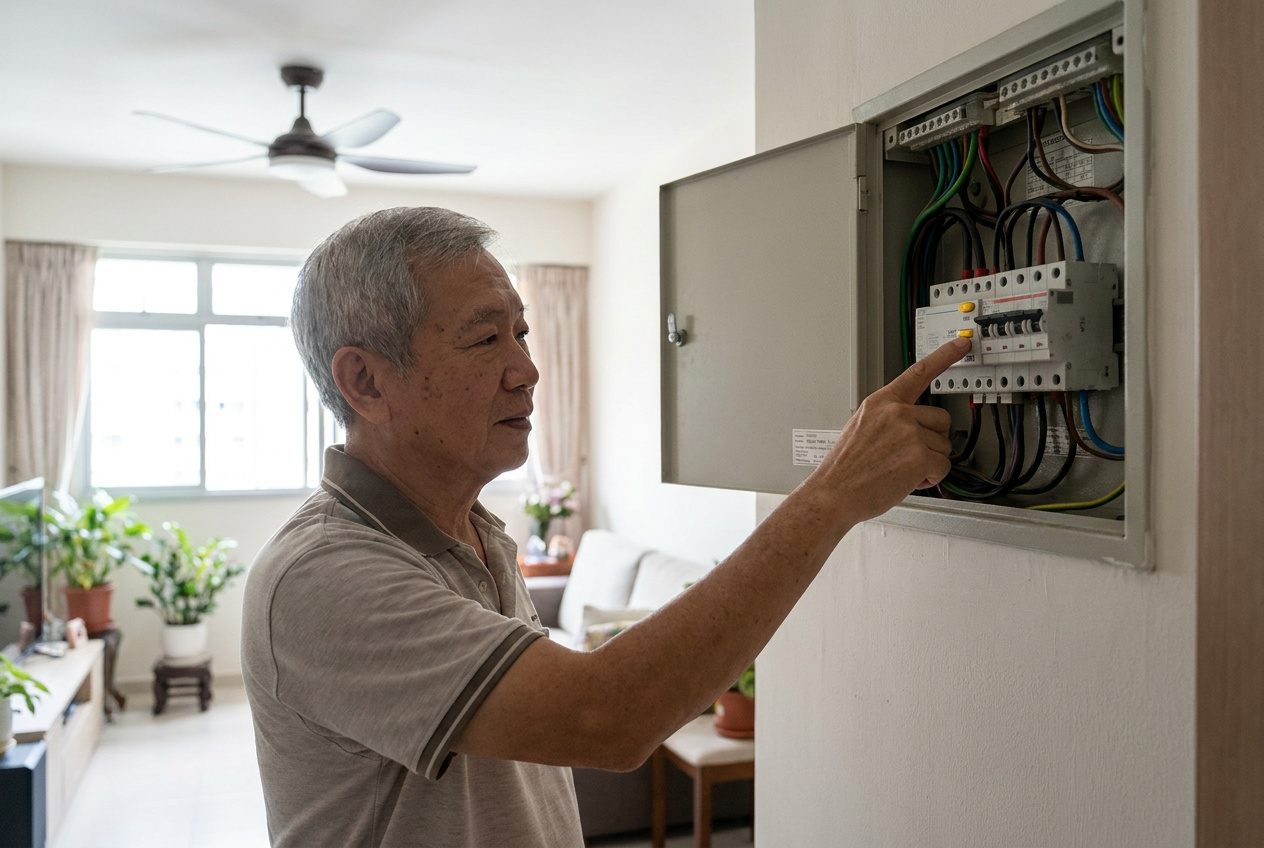
In the first five minutes of an electrical emergency, your actions count for more than any repair we make afterwards. The choices you make before help arrives can prevent injury, limit damage, and even save a life.
This guide walks through the immediate steps for the most common electrical emergencies in Singapore homes. Read it now, while everything is calm, so you are ready if something goes wrong.
Steps that apply to every emergency
Whatever the situation, start with these.
- Stay calm. Take a breath. Clear thinking stops a small problem becoming a worse one.
- Cut the power if it is safe. Go to your DB box and switch off the main switch to kill power across the whole flat. If the path there is blocked by fire or flooding, leave instead.
- Do not touch anything wet while electricity is involved. If the floor is wet or you are standing in water, keep clear of any electrical equipment and the DB box. Get to dry ground first.
- Call for help. For fire or a medical emergency, call 995 (SCDF). For a supply problem, call 1800-778-8888 (SP Services). For an internal fault, call your emergency electrician.
- Get out if you have to. If you see fire, heavy smoke, or smell strong burning from the walls, get everyone out and close the door behind you. Do not use the lift.
Scenario 1: burning smell from a socket or switch
A burning smell near a socket or switch is a serious warning. It usually means overheating, from a loose connection, an overloaded circuit, or a failing part.
- Unplug any appliance on that outlet, or switch off the circuit at the DB box.
- Stop using that socket or switch.
- Look for discolouration, melting, smoke, or heat coming off the wall.
- If you see fire or smoke, switch off the main power and leave.
- If there is no visible fire, open windows to ventilate and call an electrician.
- Do not yank the plug out if the socket is sparking or damaged. Switch off the circuit at the DB box first.
- Do not ignore the smell and hope it clears. A burning electrical smell means active damage.
- Do not pour water on the socket.
Scenario 2: your flat loses all power
When the flat goes dark, the first question is whether the fault is on the supply side (SP Services) or inside your own system.
Quick check: look out the window or into the common corridor. If your neighbours have lights, the fault is inside your flat. Open your DB box; if the main switch or RCCB has tripped, it is internal. If the main switch is still on but you have no power, it may be supply-side.
If it is an internal fault, work through the reset: switch off all MCBs, reset the main switch and RCCB, then switch the MCBs back on one at a time. If the RCCB trips again as a particular MCB goes on, that circuit has a fault. Leave it off and call an electrician.
If it is supply-side, call SP Services on 1800-778-8888. Keep the fridge and freezer shut to protect the food, and use a torch rather than candles to avoid a fire risk.
Scenario 3: someone gets an electric shock
An electric shock is a medical emergency. How serious it is depends on the voltage, how long the contact lasted, and the path the current took through the body.
- Do not touch the person while they are still in contact with the source, or you become the second casualty.
- Switch off the power at the DB box, or unplug the appliance if you can reach it safely.
- If you cannot cut the power, use a dry, non-conductive object (a wooden broom handle, a plastic chair, a dry towel) to push them clear of the source.
- Call 995 immediately for an SCDF ambulance.
- If they are unconscious and not breathing, start CPR if you are trained.
- If they are conscious and breathing, keep them still and comfortable until the paramedics arrive.
Scenario 4: water meets electricity
Flood water reaching a socket, a burst pipe near the DB box, or any water touching your electrical system is extremely dangerous.
- Do not step into the water if there is any chance it touches sockets, cables, or equipment.
- If you can reach the DB box without stepping in water, switch off the main power.
- If you cannot reach it safely, leave the flat and call an emergency electrician, plus SCDF if needed.
- Do not try to unplug appliances sitting in or near the water.
- Once the water has gone and the power is off, leave it off until an electrician has inspected the system.
Your emergency contact list
Save these in your phone now. Having them ready saves critical time.
- SCDF (fire and ambulance): 995, for fire, medical emergencies, and electric shock.
- SP Services: 1800-778-8888, for supply-side power failure and damaged power lines.
- Your emergency electrician: for internal faults, DB box issues, and burning smells.
- Police: 999, if you suspect arson or criminal damage.
What is the SP Services emergency number?
The SP Services 24-hour emergency hotline is 1800-778-8888. It is toll-free and open any time, day or night, for electricity supply emergencies. SP Services handles the supply side, meaning the power coming into your building rather than faults in your own wiring.
Call them if your whole block or neighbourhood has lost power, if you see damaged power lines or infrastructure outside your property, or if there is a problem with the meter or incoming supply cable. For faults inside your flat, such as a tripped DB box, a sparking socket, or a burning smell, you need a private electrician instead. SP Services will not repair internal wiring or your distribution board.
Save both numbers: SP Services for supply-side emergencies, and your electrician for internal faults. Then you can act in seconds rather than searching while stressed.
Should I touch someone who is being electrocuted?
No. Never touch someone in contact with a live source with your bare hands. If you do, the current flows through you too, and now there are two casualties.
Instead: switch off the power at the main switch in your DB box, or unplug the appliance if it is safe. If you cannot reach the source, use a dry, non-conductive object to push them clear, such as a dry wooden broom handle, a dry plastic chair, or a rolled-up newspaper. Never use anything wet or metallic.
Once they are clear of the source, call 995 (SCDF ambulance) at once. Check whether they are breathing and responsive. If they are unconscious and not breathing normally, begin CPR if you are trained. Even if they seem fine, they should still see a doctor. A shock can cause internal injuries, heart rhythm problems, and burns that are not visible at first. Knowing the right response before it happens could save a life.
Can I use water to put out an electrical fire?
No, never use water on an electrical fire. Water conducts electricity, so pouring it on can shock anyone nearby, including you. It can also spread the fire or cause a steam explosion if it hits very hot components.
For a small electrical fire, use a carbon dioxide (CO2) extinguisher or a multi-purpose ABC dry powder extinguisher. Both are non-conductive and safe on live equipment. In Singapore, electrical fires are Class E under SS 578, shown by a lightning bolt symbol rather than a letter. Look for that lightning bolt, or wording like "suitable for live electrical equipment", when buying one. Avoid anything marked Class C here, since that rating covers flammable gases like LPG and propane, not electrical fires. With no suitable extinguisher to hand, your safest move is to leave and call 995.
Before tackling any electrical fire, cut the power at the main switch if it is safe. Once the supply is off, it becomes an ordinary fire you can treat accordingly, though still with care. Every Singapore home should keep at least one extinguisher rated for electrical fires. Check yours has not expired and that everyone knows where it is. SCDF recommends keeping extinguishers near the kitchen and along exit routes.
What causes electrical fires in Singapore homes?
The most common causes are overloaded circuits, deteriorating wiring insulation, loose connections, and faulty appliances. Older flats that have not been rewired in decades, often those over 20 years old, may have insulation that has gone brittle and cracked, leaving conductors that can arc and ignite nearby materials.
Overloaded circuits are widespread, especially when extension cords and multi-plug adaptors are chained together (daisy-chaining) to run more devices than the circuit was built for. Every extra connection adds resistance and heat. Loose connections at sockets, switches, or inside the distribution board create local hot spots that can ignite plastic housings or nearby combustibles over time.
Faulty appliances with damaged cords or internal defects can also start fires. The risk climbs when heat-producing devices like irons, toasters, and older chargers are left running unattended. Regular repairs and maintenance catch these risks early, including thermal imaging that reveals hot spots you cannot see.
How do I create an electrical emergency plan for my family?
It takes about 30 minutes and could make a real difference. Start by finding your DB box and making sure everyone at home knows where it is and how to switch off the main power. Label the circuits clearly so anyone can isolate a specific one.
Next, make an emergency contact card with 995 (SCDF for fire and ambulance), 1800-778-8888 (SP Services 24-hour hotline), and your electrician's emergency number. Put copies near the DB box and on the fridge. Identify your fire escape routes and keep them clear. HDB flats have designated routes through the common corridor and staircase. Pick a meeting point outside the building for everyone to gather after evacuating.
Get a fire extinguisher suitable for electrical fires, such as a CO2 or ABC dry powder type (look for the lightning bolt symbol or "suitable for live electrical equipment"), and keep it accessible, not buried behind furniture. Teach everyone the basics: how to switch off the main switch, how to leave safely (no lift during a fire), and never to touch someone being electrocuted with bare hands. Run through the plan once a year. A professional inspection can find hazards before they ever become emergencies.
Be prepared
Electrical emergencies are rare, but when one strikes, preparation makes all the difference. The steps here are simple to learn and can stop a bad situation becoming a catastrophe.
Take ten minutes today to save the emergency numbers, find your DB box, and check your fire extinguisher works. Share this guide with everyone at home so they all know what to do. For a professional safety assessment, our team can inspect your wiring and flag potential hazards before they turn into emergencies.