HDB Electrical Work Requirements: A Complete Compliance Guide for Flat Owners
Before you touch a single power point, know the rules. This guide covers HDB electrical compliance from LEW licensing and permits to the RCCB requirement and realistic costs.
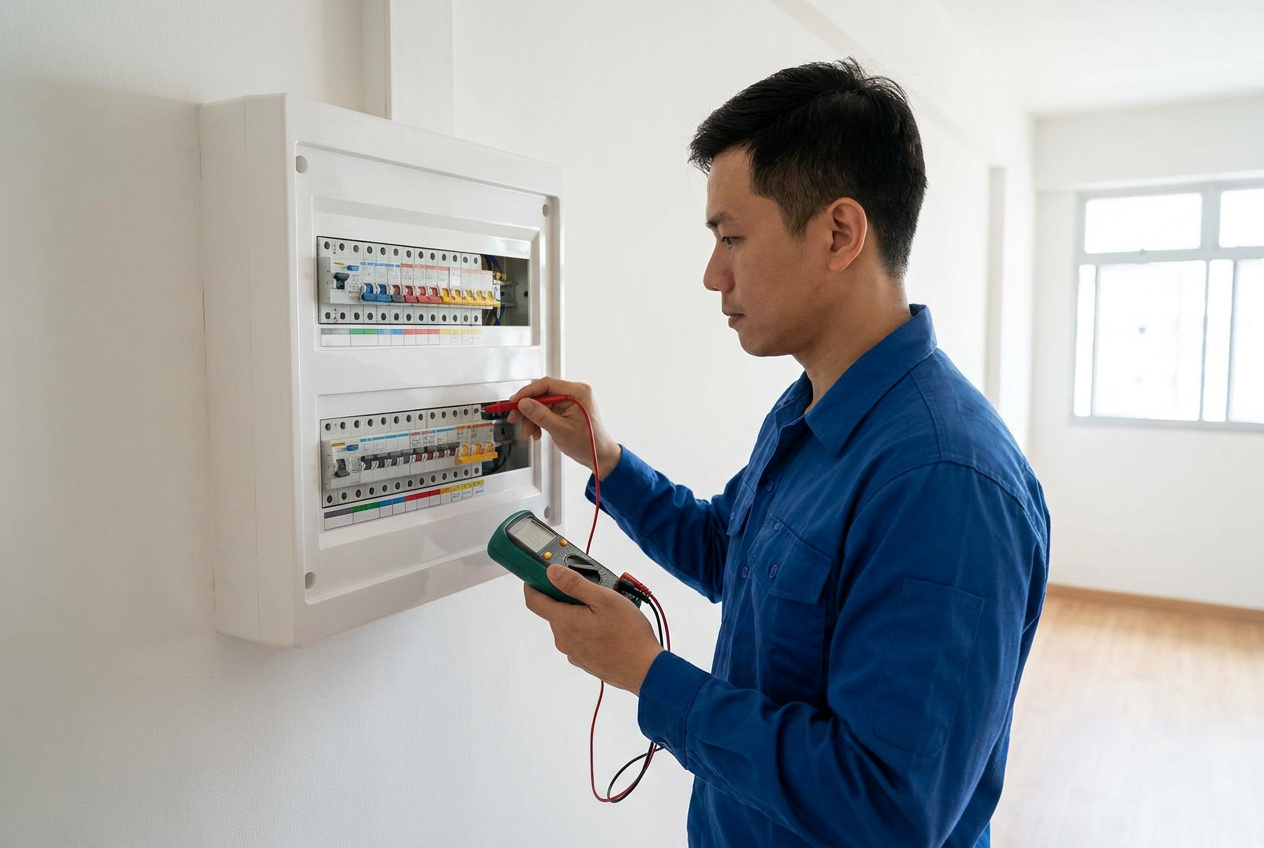
Planning electrical work in your HDB flat? Getting the compliance side right before you start saves you from costly errors, failed inspections, and real safety hazards. Whether you are redoing the kitchen, upgrading lighting, or adding power points, specific rules apply.
Plenty of owners only discover a compliance problem once work is underway, which means delays, extra cost, and sometimes a full redo. This guide walks through HDB electrical compliance end to end, from licensing to permits to meeting the safety standards.
Understanding HDB electrical work categories
HDB electrical work splits into three categories, each with its own licensing and compliance needs.
Licensed Electrical Work (LEW). This covers any change to your flat's fixed electrical installation: cables concealed in walls, ceiling fixtures, and anything permanently tied to your distribution board. Typical jobs include adding power points, replacing the DB, fitting ceiling lights, and upgrading circuits. Under Singapore's Electricity Act, all LEW must be done by an EMA-licensed electrician holding the right grade.
Notifiable work requiring permits. Some projects need HDB approval before work starts, even with a licensed electrician on the job. These usually affect common services, structural elements, or building systems. Examples include upgrading main circuit capacity, installing central air-conditioning that affects common areas, and major rewiring that touches building infrastructure.
Minor non-LEW tasks. A few jobs do not need a licensed electrician because they do not touch fixed installations: changing light bulbs, swapping portable appliance plugs, and replacing plug-in light fittings. If you are unsure whether your work counts as LEW, ask a licensed electrician. Doing LEW without a licence carries serious penalties.
Licensing requirements for HDB electrical work
Singapore's Electricity Act allows only licensed electrical workers to carry out electrical installation work in HDB flats. Licensed Electrical Workers (LEWs) are registered with the Energy Market Authority and hold a licence that shows their level: Grade 7 (L7) Licensed Electrician, Grade 8 (L8) Licensed Electrical Technician, and Grade 9 (L9) Licensed Electrical Engineer. For typical HDB residential work, a Grade 7 or Grade 8 licence is appropriate.
Verify before you hire. Check an electrician's licence on the EMA website using their licence number or NRIC. This shows whether the licence is active, the grade held, and the expiry date. Never assume someone is licensed from the company name alone. Licensed electricians carry an EMA certification card, so ask to see it before work begins.
Consequences of using unlicensed workers. Using unlicensed labour creates several problems. It is illegal under the Electricity Act, and both the flat owner and the worker can face prosecution and significant fines. Insurers may void claims tied to electrical faults if the work was done by an unlicensed person, leaving you personally liable for damage or injury.
It also complicates a future sale. Buyers may uncover compliance issues during inspection, which can mean lower offers or redoing the work at your cost. Most important of all, unlicensed work compromises safety, raising the risk of fire and electrocution.
The LEW application process for HDB flats
Before your licensed electrician starts, they must submit a Licensed Electrical Work application to SP Group (the operating entity that handles supply connection and LEW approvals) through its eBusiness Portal. For residential installation and turn-on submissions, this is commonly called the CS/5H form.
When an LEW application is required. Your electrician submits one whenever the work changes your fixed electrical installation. The application records the planned work, confirms it meets safety standards, and creates an official record that matters for future renovations, resale, and insurance.
The application timeline. LEW applications usually process within one to two weeks, depending on SP Group's workload and how complete your submission is. Your electrician applies before starting work. Once approved, work proceeds. After installation, your electrician tests the system, then lodges completion documentation (typically a CS/5H completion certificate) with SP Group. SP Group may inspect the work, especially for major installations.
LEW application costs. Application fees depend on the scope and are usually quoted by your LEW as part of the overall job. There is no single published price list, so market figures vary. Reputable electricians fold the LEW application cost into the quote upfront so nothing catches you off guard.
HDB permit requirements for electrical work
Beyond the LEW application, some projects need specific HDB approval before they go ahead.
When HDB permits are needed. HDB requires permits for work that affects building structure, common property, or building systems: hacking walls or ceilings to run new cables, upgrading supply capacity, installing central air-conditioning that affects common areas, and major rewiring.
The HDB renovation permit process. This involves submitting detailed plans of the proposed work. Processing usually takes two to three weeks. HDB charges permit fees based on scope; for minor electrical changes done as part of a larger renovation, the fee is usually wrapped into the standard renovation permit cost of around S$100.
Coordinating LEW and HDB permits. For projects needing both, time them carefully. As a rule, secure HDB approval first to confirm your planned work is acceptable, then have your electrician lodge the LEW application based on the approved plans.
Safety standards and compliance requirements
Your installation must meet Singapore's electrical safety standards to pass inspection and run safely.
Singapore Standard SS 638. All electrical installations must comply with SS 638, the Code of Practice for Electrical Installations. For HDB flats, the key points include proper circuit sizing from load calculations, the right protection device on each circuit, correct cable types and installation methods, proper earthing throughout, and adequate residual current protection.
Circuit protection and safety devices. Modern HDB flats need full circuit protection. Your distribution board should carry miniature circuit breakers (MCBs) for overload protection and residual current circuit breakers (RCCBs) to guard against earth leakage. When upgrading older flats, swapping dated protection for modern MCBs and RCCBs improves safety considerably. For a side-by-side look at the older ELCB technology versus today's RCCB standard, see our guide on ELCB vs RCCB for Singapore homeowners.
Mandatory RCCB requirement (effective 1 July 2025)
Under the Electricity (Electrical Installations) (Amendment) Regulations 2025 (S 454/2025), every residential installation in Singapore must be protected by an RCCB as of 1 July 2025. Non-compliance carries a fine of up to S$5,000. For older HDB flats wired before RCCBs became standard, retrofitting has been supported through government assistance: eligible pre-1985 HDB 1-room and 2-room flats have been offered a 100% subsidy for RCCB installation, and pre-1985 3-room and larger flats a 95% subsidy, based on published EMA and HDB assistance schemes. Eligibility and scheme terms can change, so confirm current details with your licensed electrician or on the EMA website before you proceed.
Wiring in structural elements
HDB does not allow new electrical wiring to be embedded inside reinforced concrete (RC) structural elements such as RC slabs, beams, or columns, since this can compromise structural integrity. Cables must instead run on the surface in trunking, or be concealed within non-structural walls or above false ceilings. Your LEW plans cable routes that respect these limits.
Earthing system requirements. Proper earthing is critical for safety. Singapore standards require effective earthing on all electrical systems, giving fault currents a safe path. Every piece of fixed equipment, metal enclosure, and exposed conductive part must be properly bonded to earth. Testing the earthing is part of the LEW completion process.
Cost factors and budgeting for compliant work
Knowing the cost structure helps you budget accurately and choose well.
Pricing components. Compliant work includes labour for your licensed electrician, materials for cables and components, LEW application fees (quoted as part of the job), HDB permit fees (around S$100 for standard renovations), and testing and certification.
Typical price ranges. Based on common market ranges in Singapore (actual pricing varies by scope, materials, site conditions, and electrician): individual power point installations are commonly quoted around S$80 to S$150 per point, distribution board replacement around S$400 to S$1,200, complete rewiring for a 4-room flat roughly S$3,000 to S$8,000, ceiling fan point installations around S$120 to S$250 per point, and adding lighting circuits around S$150 to S$400 per circuit. Always get a written quote from a licensed electrician for your specific job rather than leaning on general ranges.
The value of compliance. Compliant work costs more than hiring unlicensed labour, but the value justifies it. The installation meets safety standards, cutting fire and electrocution risk. The work is documented and passes inspection, which adds value at resale. Legal compliance protects you from prosecution and fines, your insurance stays intact, and proper certification gives peace of mind.
Common compliance mistakes to avoid
Knowing the usual pitfalls helps you sidestep them.
Starting before approvals. Never begin while you are still waiting on approval. If the application is rejected or needs changes, you may have to undo finished work and restart, doubling the cost. Wait for every approval before any work begins.
Assuming all electricians are licensed. Not everyone offering electrical services holds proper LEW licensing. Always verify credentials before engaging anyone. Ask for the LEW certificate and confirm the licence status with EMA.
DIY on LEW work. Changing bulbs or plugs is fine, but anything involving fixed installations needs a licensed electrician. DIY on fixed installations is illegal no matter how skilled you are, voids insurance, and creates hazards.
Choosing on price alone. Picking the cheapest quote often leads to trouble. Get several quotes from licensed electricians, then judge on reputation, verified licensing, a detailed scope, and a real understanding of the whole project.
Incomplete documentation. Keep everything: LEW applications, completion certificates, test reports, and permits. This proves compliance and matters for resale and future renovation work.
Working with licensed electricians
Choosing and working well with a licensed electrician keeps your HDB electrical work on track.
Finding qualified electricians. Ask friends, family, or neighbours who recently had electrical work done. Online reviews add to the picture, but verify licensing independently. When you call, ask specifically about their HDB residential experience.
The quotation process. Request detailed written quotes from at least three licensed electricians. A good quote should include a clear scope, material specifications, labour costs, LEW application fees, a completion timeline, testing and certification, and warranty terms. During site visits, ask how they will ensure compliance, what testing they do, and how they handle surprises. Their answers reveal their professionalism.
Managing the work. Set clear expectations on timeline and process. Confirm when they will lodge the LEW application, when work starts, and the expected completion date. Ask to see the LEW application before submission to check it matches your agreed scope.
Completion and documentation. After the physical work, your electrician tests everything against safety standards. Ask for copies of all completion documents: the CS/5H completion certificate lodged with SP Group, test reports, and warranties on materials and workmanship. Before the final payment, confirm the system works as expected.
Frequently Asked Questions
Do I need a licensed electrician for all electrical work in my HDB flat? You need one for any Licensed Electrical Work (LEW), which covers changes to your fixed installation: your distribution board, cables concealed in walls or ceilings, new power points, extra circuits, ceiling light installation, and anything permanently connected to your system. Non-LEW tasks like changing bulbs, swapping portable plugs, or replacing plug-in fittings do not need a licensed electrician. The line is not always obvious; replacing a ceiling light looks simple but counts as LEW because it ties into concealed wiring. The safest move is to ask a licensed electrician whenever you are unsure. Under the Electricity Act, doing LEW without a licence can mean prosecution and fines for both owner and worker, and insurers may deny claims if investigation reveals unlicensed work. For renovations or upgrades, always use licensed electricians. Our HDB residential LEW services keep your work compliant and safe.
How long does the LEW application process take? It usually takes one to two weeks subject to SP Group processing, once your electrician submits the CS/5H form and supporting documents through SP Group's eBusiness Portal. Timing varies with complexity and current volumes. Plan for this when scheduling. After approval, work begins; once installation is done, your electrician tests it and lodges completion documents, typically processed within a few days. Some projects draw a physical inspection, which needs extra scheduling. The full timeline from submission to final certification usually runs two to three weeks for straightforward installations, and four weeks or more for complex jobs. Working with electricians familiar with SP Group's requirements helps applications pass on the first try.
What happens if I do work without proper licensing or permits? It creates serious legal, safety, and financial problems. Under the Electricity Act, unlicensed electrical work is a criminal offence, and both owner and worker can face prosecution and fines reaching thousands of dollars. Insurance is another risk: policies typically require licensed professionals, so if a fault causes fire, damage, or injury and investigators find unlicensed work, the insurer will likely deny the claim, leaving you liable. Resale gets harder too, as inspectors may flag non-compliant work, leading to lower offers, redo requirements, or buyers walking away. Most critically, substandard work puts your family at risk of fire, electrocution, and equipment damage. If you find earlier unlicensed work in your flat, get a licensed electrician to inspect it and bring it up to standard.
Can I upgrade my HDB electrical system capacity, and what approvals do I need? Yes, but it needs coordination across parties. Capacity upgrades involve changes to your distribution board, possibly your service cable, and coordination with SP Group on your flat's supply rating. Note that flats built before 1994 were typically provisioned with a 30A main switch, while those from 1994 onwards generally have a 40A main switch; knowing which you have helps gauge whether an upgrade is needed for your appliance loads. For DB upgrades that add circuits or modern safety devices without raising overall capacity, you need an LEW application through your electrician. For major increases to support more high-power appliances, you may need to upgrade the main service cable and supply rating, which requires an application to SP Group. HDB approval comes in when work affects common property or building systems. Costs vary: simple DB upgrades with added circuits are generally quoted in the region of S$600 to S$1,500, while major supply upgrades with service cable replacement and higher capacity may run roughly S$2,000 to S$5,000 or more. A load assessment by a licensed electrician shows whether your current capacity is enough or what upgrade you need. Our electrical installation services include load assessment and capacity planning.
What should I look for when verifying a licence? Verifying properly protects you from unqualified workers and takes only a few minutes. The main method is the Energy Market Authority website: ask for the electrician's LEW licence number and NRIC, then search the EMA database. This confirms the licence is active, shows the grade held (L7, L8, or L9), and shows issue and expiry dates. Grade matters; for typical HDB residential work, L7 or L8 is appropriate. Ask for the physical EMA certification card too, which shows the photo, licence number, grade, and validity. Genuine LEWs carry these and expect you to check. Hesitation or an invalid card is a serious warning sign, as are claims of a licence with no number to verify, prices well below market, suggestions to skip the LEW application, or pressure to start immediately. Our licensed electrical workers bring deep HDB experience and meet Singapore's safety standards.
How do I coordinate electrical work with other renovation activities? It takes planning and clear communication across trades. Start electrical planning early in the design phase. Before finalising layouts for kitchens, wardrobes, or feature walls, fix your power point locations, lighting positions, and special requirements. Submit your HDB renovation permit including the electrical detail; once approved, your electrician lodges the LEW application. Hacking and cabling need coordination between electrical and building works: electricians usually need access during hacking to create cable routes before plastering, and for ceilings they install cabling and mounting points before the false ceiling goes up, with fixtures and fans fitted after the ceiling but before final painting. Plan final testing after all electrical work is done, ideally before handover. Weekly progress meetings, shared documentation of electrical requirements, and some scheduling flexibility all help. Most IDs and main contractors have established processes for this, and an experienced HDB electrician can advise on the best timing for each phase.
Conclusion
Understanding HDB electrical work requirements protects your safety, keeps you on the right side of the law, and helps your renovation run smoothly. The licensing, permits, and regulations can feel complex at first, but they exist to keep Singapore's homes safe.
Working with licensed electricians, following the proper application steps, and meeting the safety standards gives you confidence the job is done right. Compliant work pays off through better safety, intact insurance, and stronger property value.
For all your HDB electrical needs, our HDB residential LEW services support you from planning through completion certification, handling the whole process so your installation meets every HDB requirement and delivers a safe, reliable system for your home.