Power Trip Prevention: Electrical Maintenance Tips for Singapore Homes
Most power trips build up slowly from overloaded circuits, ageing parts, and loose connections. A little regular maintenance keeps your system reliable and your evenings uninterrupted.
Power trips are far easier to prevent than to fix in the middle of a dark evening. Most of them come from conditions that build up over time: overloaded circuits, ageing components, loose connections, and neglected appliances. A bit of regular maintenance keeps your electrical system reliable and your evenings running smoothly.
This checklist covers what you can safely do yourself and when to bring in a professional. Work through it at your own pace.
Monthly checklist
These are quick jobs you can handle yourself. Set a monthly reminder.
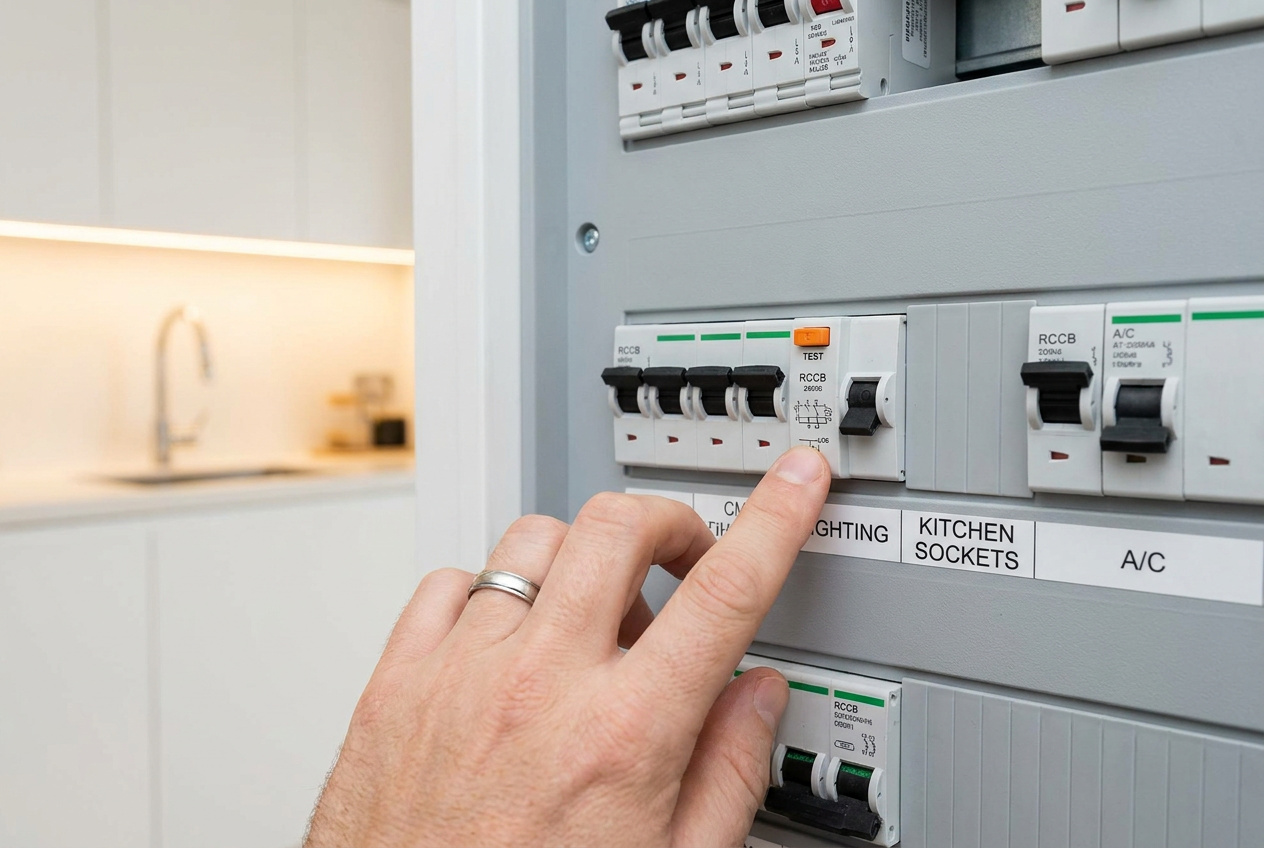
- Test your RCCB or ELCB. Press the test button on the device in your DB box. It should trip instantly. Switch it back on to reset. If it does not trip, book a professional check.
- Feel for warmth at sockets and switches. Run your hand near (not touching) sockets and switches during normal use. Unusual warmth points to a loose connection or an overloaded circuit.
- Inspect visible power cords. Check appliance cords for fraying, cracking, exposed wire, or bent prongs. Replace any damaged cord straight away.
- Listen for odd sounds. Buzzing, crackling, or sizzling from sockets, switches, or the DB box is not normal. It signals arcing or loose connections.
- Check your extension cords. Make sure none are daisy-chained into each other, and that none run under carpets or through doorways where they can be crushed.
Quarterly DB box checks
Every three months, spend ten minutes on these.
- Open the DB box and look it over. Check for discolouration, scorch marks, moisture, or corrosion on any part. If you spot any, book a professional inspection.
- Check the circuit labels. Confirm they are still legible and accurate, and update any that have changed, for example after adding new appliances to a circuit.
- Review the loading. Think about whether you have added high-power appliances lately. If a circuit seems more heavily loaded, consider spreading appliances to balance things out.
- Test the main switch. Flip it off and back on. It should move smoothly and click firmly into place. A loose or stiff toggle can mean a worn switch.
- Look for pests. Lizards, ants, and cockroaches can nest in DB boxes. Droppings or dead insects inside the box suggest a pest problem worth sorting out.
Annual professional inspection
Once a year, or every 3 to 5 years at the very least, have a licensed electrician do a thorough inspection.
- Book a DB box service. We tighten all connections, test every MCB, and run a calibration test on the RCCB or ELCB.
- Ask for insulation resistance testing. This catches degrading wiring insulation before it causes tripping or fire risk, and it matters most for flats over 15 years old.
- Ask about thermal imaging. An infrared scan of your DB box and key sockets reveals hot spots from loose connections or overloaded conductors.
- Review your circuit capacity. We can assess whether your circuits are sized for how you actually use them, especially if your appliances have changed.
Signs your wiring needs attention
Between scheduled inspections, keep an eye out for these.
- Frequent tripping with no clear cause. If a breaker trips often and you cannot pin it to one appliance, the wiring on that circuit may be deteriorating.
- Flickering lights. Lights that flicker or dim briefly can mean loose connections or a circuit running short of capacity.
- Warm or discoloured sockets. Heat at a socket means resistance in the connection, which generates more heat and can become a fire risk.
- A faint burning or plasticky smell. Even a slight electrical smell near sockets, switches, or the DB box deserves professional investigation.
- Appliances underperforming. Heaters slow to warm up or lights dimmer than usual can mean voltage drop from poor connections or undersized wiring. Some of this is seasonal in Singapore, tracking monsoon humidity or lightning activity.
Smart devices that help
Technology can support your maintenance routine, though it cannot replace it.
- Energy monitoring plugs show real-time power use for a connected device, helping you spot energy hogs and avoid overloading a circuit.
- Smart power strips with surge protection cut power when devices exceed safe levels and guard against surges.
- Whole-house energy monitors connect to your DB box and show per-circuit consumption, making it easy to find circuits running near capacity.
- Smart switches with scheduling stagger high-power appliances so they do not all run at once on the same circuit.
How often should I service my DB box?
For most HDB flats, a professional inspection every 5 years is reasonable. Flats with older systems, over 15 years, are better served every 3 years. A service covers a visual inspection, connection tightening, RCCB calibration testing, and insulation resistance measurement.
Between professional visits, test your RCCB monthly with its test button. A professional DB box inspection typically costs S$80 to S$150. If your flat has never had one, that first visit is especially worthwhile.
Can smart plugs help prevent power trips?
Smart plugs with energy monitoring can help prevent overload trips by showing real-time consumption, and some cut off automatically when load passes a threshold. What they cannot do is prevent earth leakage trips, short circuits, or wiring faults.
Choose reputable brands carrying the SAFETY Mark. Do not use smart plugs for very high-power appliances that should have their own dedicated circuits. They work best as monitoring and scheduling tools for moderate-load devices.
What maintenance does an HDB electrical system need?
It works at three levels. Monthly: test your RCCB, check sockets for warmth, inspect power cords. Every 3 to 5 years: a professional DB box inspection, insulation resistance testing, and thermal imaging. As needed: DB box replacement, an ELCB to RCCB upgrade, dedicated circuits for new appliances, and rewiring.
How do I know if my wiring is too old?
Age is the main indicator. Wiring in flats built in the 1980s or 1990s may be 30 to 40 years old. Physical signs include yellowing insulation, warmth at sockets, and discolouration. Electrical signs include frequent unexplained tripping. A professional insulation resistance test is the definitive check.
Is preventive maintenance worth the cost?
A professional inspection costs S$80 to S$150. A single emergency call-out costs S$150 to S$400 or more. One inspection can head off several emergency visits. Early detection means planned repairs instead of urgent ones. Regular maintenance also lowers fire risk from loose connections and gives you documentation for insurance. It keeps your costs predictable.
What does a professional inspection cover?
A thorough inspection covers a DB box visual check and connection tightening, MCB and RCCB testing, insulation resistance measurement on all circuits, earth continuity verification, a visual check of sockets and switches, a circuit loading assessment, and optionally thermal imaging. You get a report with findings and prioritised recommendations.
Staying ahead of problems
Electrical maintenance is not glamorous, but it is one of the most cost-effective ways to prevent power trips, lower fire risk, and extend the life of your system. If a trip does happen despite your best efforts, the response steps are straightforward.
Start with the monthly checklist and build the habit. When it is time for a professional inspection, our preventive maintenance and troubleshooting services give you a thorough assessment and clear recommendations. Your electrical system runs quietly in the background every day; a little attention keeps it that way.