Electrician for Your Condo: Services, Rules, and What to Know
Condo electrical work plays by different rules than HDB: MCST approvals, higher capacity, and building access. Here is how to plan it without the delays that catch owners out.
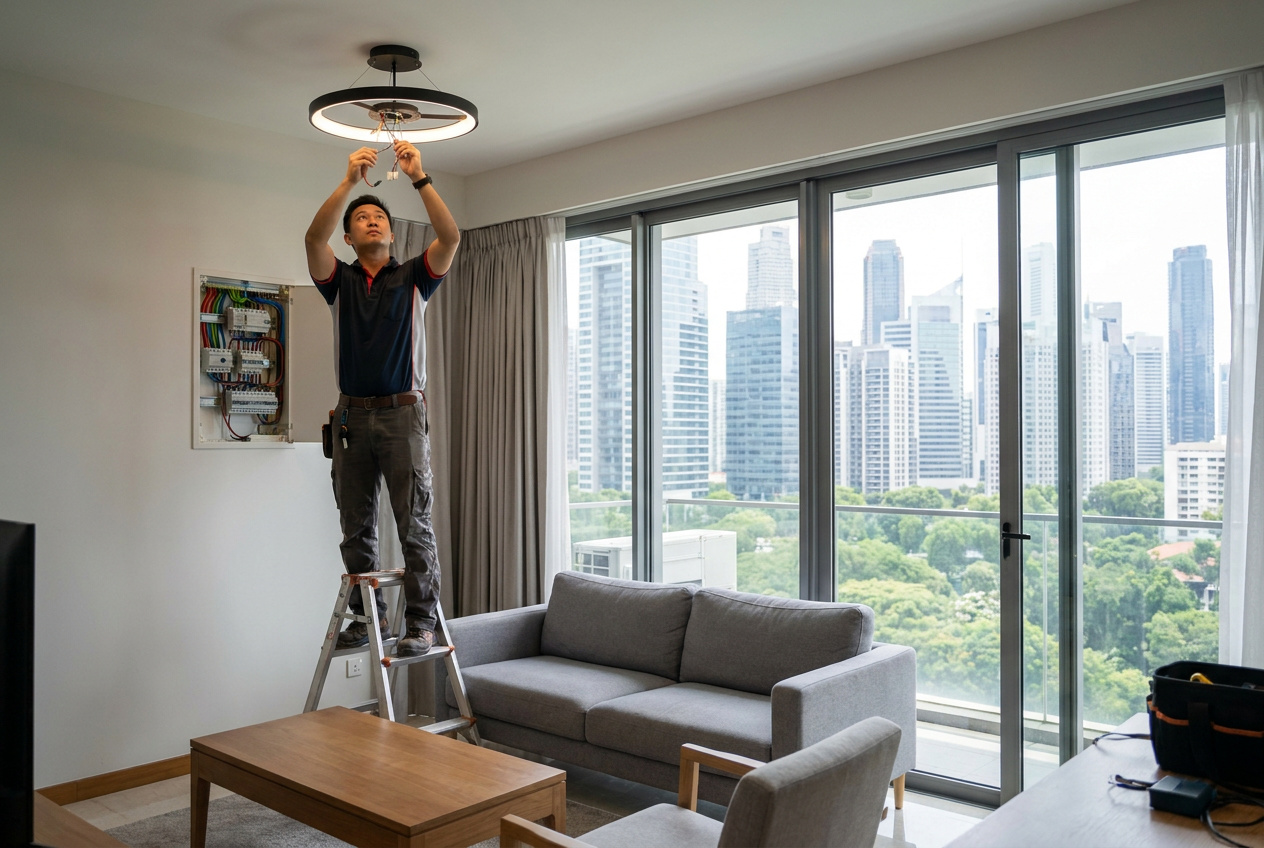
If you own a condo in Singapore, your electrical needs come with their own set of considerations compared with HDB living. MCST approvals, different wiring setups, and building-specific rules all come into play. Knowing the differences helps you plan electrical work better and dodge the delays that catch unprepared owners off guard.
We will cover how condo electrical services differ from HDB, what common work looks like, and the practical steps to get it done within your development's framework.
How condo electrical differs from HDB
The core electrical principles are the same, but working in a condo plays out differently from an HDB flat in a few ways.
Higher capacity. Most condo units have more supply capacity than HDB flats. A 3-bedroom condo might run on 60A single-phase compared with 40A for a similar HDB flat. Some larger units and penthouses have three-phase supply, which opens the door to high-power installations without the supply upgrade headaches HDB owners sometimes hit.
More complex distribution. Condo units often carry more circuits in the DB box, reflecting the higher capacity and the expectation that owners will run more equipment. A typical condo DB box might have 16 to 20 ways against 10 to 12 in an HDB flat.
Building management rules. This is where condo work gets its own flavour. Most developments have renovation guidelines setting permitted hours (often 9am to 5pm on weekdays, sometimes with Saturday mornings allowed), contractor registration, and noise limits. These shape scheduling and sometimes the kind of work allowed.
Access to supply infrastructure. In an HDB flat your SP Services meter sits right at your front door. In a condo it might be in a centralised electrical room or riser cupboard, and reaching it can mean coordinating with the management office, which adds a step to any work on the main supply.
Common condo electrical services
Condo owners call on electricians for a range of work, some of it specific to private property living.
Smart home installations. Condos are often where smart home adoption starts in Singapore. Smart lighting, motorised blind wiring, video doorbells, and whole-home automation all need careful electrical planning. The higher capacity in condos makes these systems easier to support without circuit upgrades. Explore our smart home automation services for what is possible.
Kitchen electrical upgrades. Moving from gas to induction cooking is increasingly common. An induction hob needs a dedicated 32A circuit, and if you are also running a built-in oven and other high-power appliances, the circuits must be planned properly to avoid overloading.
Lighting redesign. Many owners invest in lighting during renovation: converting to LED throughout, adding dimming circuits, fitting cove and feature lighting, and creating separate zones for different moods.
EV charger installation. As electric vehicle ownership grows, condo EV charging is now a regular request. The electrical work itself is straightforward for a qualified electrician, but the MCST coordination adds a layer.
Rewiring for older developments. Condos from the 1990s or earlier can benefit from full or partial rewiring, especially where older cable insulation is degrading. This is best done during a renovation while walls and ceilings are open.
MCST approvals and coordination
Working through MCST requirements is one of the defining features of condo electrical work. Here is what to expect.
Renovation notification. Nearly all condos require you to register your renovation with the management office before work begins. This usually means submitting a renovation form, paying a refundable deposit (the amount varies by condo, so check with your MCST), and registering your contractors. The deposit covers possible damage to common areas.
Work hour compliance. Your electrician works within the development's permitted hours, which can limit how much gets done in a day compared with HDB work, where restrictions are generally looser.
Common area modifications. If your work touches anything outside your unit boundary, you need explicit MCST approval. That includes running cables through common corridors, accessing the electrical riser, or modifying shared infrastructure. For EV chargers in car parks, you may need to put your proposal to a council meeting or general meeting.
Coordination with building maintenance. For work involving the main supply or metering, you may need the building's maintenance team present or to arrange access to locked electrical rooms. Sort this out ahead of time so nothing stalls on the day.
We handle MCST coordination regularly on condo projects. It does add time, but it does not have to be stressful.
Landed property considerations
Landed homes, including terrace houses, semi-detached properties, and bungalows, have their own electrical character.
Three-phase supply. Many landed properties have three-phase supply, giving far more capacity than the single-phase supply in most flats. This supports high-power systems like central air conditioning, pool pumps, electric gate motors, and EV chargers without supply constraints.
Longer cable runs. Larger homes mean longer runs from the DB box to distant rooms or outbuildings. This affects cable sizing, since longer runs need thicker cables to hold safe voltage levels. Your electrician should size cables to the actual distances in your property.
Outdoor electrical needs. Garden lighting, gate automation, security cameras, and pool equipment all need weatherproof connections. Outdoor installations must use IP-rated (Ingress Protection) fixtures and proper cable protection.
Multiple DB boxes. Larger landed homes may have more than one distribution board, a main DB plus one or more sub-boards serving different floors or areas. This distributed setup needs careful planning to balance load across the system.
For landed work, a Licensed Electrical Worker experienced with larger residential systems matters. The complexity is greater than a flat, and the cost of poor planning is proportionally larger. Our electrical installation services cover the full range of landed property requirements.
Choosing the right electrician for private property
Picking an electrician for condo or landed work brings a few extra considerations beyond what HDB owners weigh up.
MCST experience. Ask whether the electrician has worked within condo management frameworks. One who knows MCST processes can anticipate the coordination and build it into the timeline.
LEW licensing. The licensing rule is the same whatever the property. All installation work must be done by a Licensed Electrical Worker, and for more complex installations in larger properties a higher LEW grade may be needed. See the LEW grades guide for what each grade covers.
Smart home capability. If your project involves smart home integration, make sure the electrician has experience with the systems you are planning. Smart home wiring calls for an understanding of both electrical and data infrastructure.
Portfolio of private property work. Ask for examples of past condo or landed projects. The scale and complexity differ from HDB, so relevant experience counts.
Post-renovation support. Choose someone who will be reachable after the work is done. Electrical issues can surface weeks or months later, and a direct line to the electrician who did the install makes troubleshooting far simpler.
Frequently Asked Questions
Do I need MCST approval for electrical work in my condo? It depends on the scope and where the work happens. For work inside your unit that does not affect common areas or shared infrastructure, you generally do not need MCST approval. That covers most standard jobs like adding power points, changing light fittings, or replacing your DB box. But if the work could affect common areas, shared walls, or the building's main riser, approval is usually required. Running new cables through common corridors, installing EV chargers in shared car parks, or upgrading supply through the building's main switchboard all fall here. Many condos also require you to notify the management office before any contractor work, even inside your unit. That is separate from formal MCST approval and is more about coordination: lift booking, work hours, and contractor registration. Check your condo's renovation guidelines before engaging anyone.
Can I use the same electrician for condo and HDB work? Yes. A Licensed Electrical Worker can work on both, since the licensing requirement is the same: the right LEW grade for the work being done. The differences are not about licensing but about the building's rules, access, and electrical setup. A good condo electrician should understand MCST coordination, be familiar with different building configurations, and know how to work within the access and timing restrictions condos impose. When choosing, ask specifically about condo experience; an electrician who mostly does HDB flats may be less familiar with the coordination private developments require. Our licensed electrical works services cover both property types.
What electrical upgrades are common in condos? They tend to cluster in a few areas. Smart home integration is increasingly popular: smart lighting, automated blinds wiring, smart lock power, and whole-home automation hubs. Condos suit these well thanks to newer wiring and higher capacity. Kitchen upgrades are common too, particularly switching to induction cooking, which needs a dedicated 32A circuit. Lighting redesigns to LED with dimming and feature lighting come up often, power point additions to match modern furniture layouts are standard, and EV charger installation is growing.
How does condo wiring differ from HDB? There are several practical differences. Supply capacity is often higher in condos, with 60A or 100A single-phase against 40A or 60A in HDB flats, and some larger units have three-phase. The distribution board can be more complex, with 16 to 20 ways versus 10 to 12 in HDB. Wiring follows the same Singapore Standard (SS 638), but condos often have ceiling voids that give better access for changes. Metering differs too, since condo meters may sit in centralised rooms needing management coordination to access. Building rules around renovation also tend to be stricter in condos.
Who is responsible for electrical issues in common areas? The MCST is responsible for common area systems: corridor and car park lighting, lift power, fire safety systems, and the building's main switchboard. As a unit owner, you are responsible for the electrical system within your unit from your DB box inward. The boundary is typically at your unit's meter or incoming supply cable. If something goes wrong and you are unsure whose it is, check whether the problem persists with your main switch off. If it does, it is likely a building-level issue for the MCST, so report it to your management office.
Can I install EV charging in my condo car park? It is possible but involves several stakeholders. Start by checking whether your condo has an EV charging policy, since some newer developments have pre-provisioned car parks with charging infrastructure. Without existing infrastructure, the process usually means submitting a proposal to the MCST, getting approval (which may need an extraordinary general meeting), arranging power from the building's system, engaging a licensed electrician for installation, and getting certification. Costs run from around S$2,000 for simple setups to significantly more for complex installs with long cable runs.
Your property, properly powered
Condo electrical work is straightforward once you understand the extra layers of coordination involved. The electrical work itself follows the same standards and safety rules as any property in Singapore. The difference is in how you navigate the building's management framework and plan around access.
Whether you are renovating your condo, moving to smart home systems, or planning an EV charger, working with an electrician who understands private property makes the process smoother. Our licensed electrical works team handles both the technical and coordination sides of condo projects, so you can focus on enjoying the results.